
HK Bank AML Storm & Frozen Account Recovery Guide: From Trigger to Unfreezing (Case Studies)
Hong Kong Bank AML Storm and Frozen Account Survival Guide: From Triggering Risk Control to Unfreezing Funds (With Case Studies)
In today's global environment of increasingly stringent Common Reporting Standard (CRS) and Anti-Money Laundering (AML) regulations, Hong Kong, as an international financial center, has elevated its banking risk control standards to unprecedented heights. For many business owners with Hong Kong registered companies and bank accounts (such as HSBC, BOC, Standard Chartered, Hang Seng, etc.), the most terrifying nightmare is suddenly receiving an "Administrative Review Notice (Request for Information, RFI)" from the bank, or even a cold "Account Closure Letter," followed immediately by the unannounced freezing of account funds.
Most articles on the market regarding "how to prevent bank account closures" tend to linger on extremely shallow and outdated advice like "don't transfer too frequently" or "don't trade with sensitive countries." However, when your account is already frozen, or has entered the bank's deep AML review process, these "defensive suggestions" are utterly useless.
Compiled jointly by NexvoraHK's senior compliance experts and former bank risk control officers, this article is a 5,000+ word "Pillar Content" deep-dive guide. We will completely dissect the underlying logic of Hong Kong banks' AML reviews and, through two in-depth, anonymized real-world case studies, show you how to perform emergency rescue operations within the "Golden 48 Hours" of your account being frozen, and how to engage in high-intensity appeal negotiations with the bank's Compliance Department.
Part 1: Seeing Through the Black Box—The Underlying Logic of Hong Kong Banks' AML Risk Control
To solve a frozen account problem, you must first understand how the bank "targeted" you. The risk control systems of Hong Kong banks are not entirely manual transaction-by-transaction reviews; they are driven by extremely complex "Transaction Monitoring Systems (TMS)."
1. TMS Trigger Thresholds
The TMS uses big data and machine learning algorithms to set a "normal behavior baseline" for each corporate account. Once a transaction deviates from this baseline, the system automatically generates an Alert, which is then passed to the manual compliance team (L1 Maker/Checker) for initial screening. Common fatal triggers include:
- U-Turn Transactions: Funds stay in the account for a very short time (usually under 24 hours), and large amounts of incoming funds are immediately transferred out in full or in split amounts to recipients inconsistent with the company's daily business nature. This is a classic money laundering trait.
- Commingling of Corporate and Personal Funds: Frequent transfers from the corporate account to personal accounts (especially individuals without labor contracts, or the personal accounts of company directors) without reasonable salary or dividend resolution documents.
- Transfers from High-Risk Jurisdictions: Not just sanctioned countries (like Iran or North Korea). Currently, receiving third-party proxy payments from Russia, parts of the Middle East, South America, etc., will almost 100% trigger a manual review.
- Sudden Spike after Dormancy: An account that has had no transactions for 6 months suddenly receives a remittance of hundreds of thousands of USD. This will immediately be flagged by the system as "account potentially borrowed or sold."
2. The Escalation Path of Reviews
Bank reviews are typically divided into three stages. Understanding which stage you are currently in determines your response strategy:
Stage 1: Periodic KYC Review
This is usually a routine update every 1-3 years. The bank will email you asking to fill out the latest questionnaire and provide your most recent Business Registration (BR) and list of directors. This is **not** because you made a mistake; just provide the information truthfully.
Stage 2: Event-Driven Review (RFI)
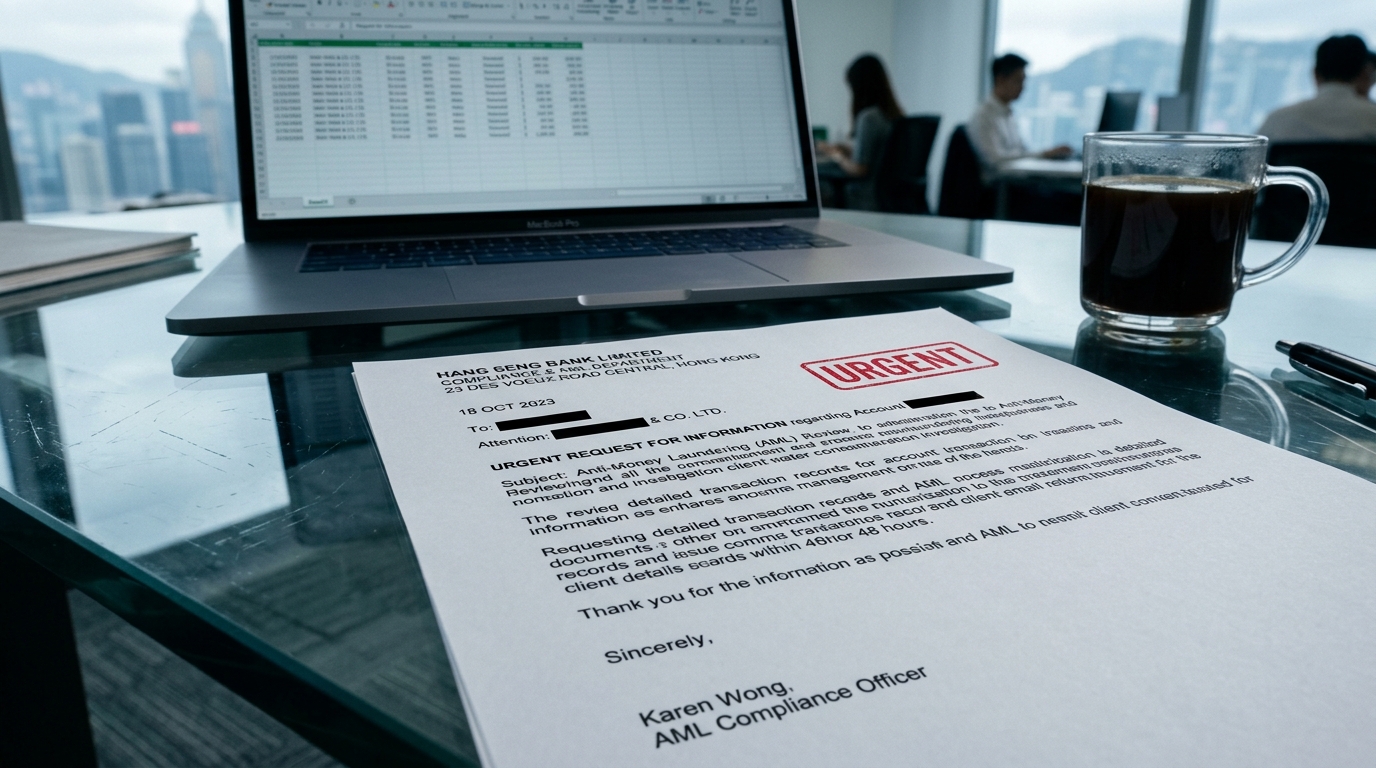
This is where the danger begins. The bank will send an email or letter regarding one or several specific transactions, demanding you provide corresponding contracts, invoices, Bills of Lading, and Source of Funds within a deadline (usually 14-30 days). At this point, your account is usually **still usable**, but this is the bank's final chance for you to prove yourself.
Stage 3: Suspension & Closure Procedure
If you fail to reply to the Stage 2 investigation in time, or if the documents provided are deemed "illogical/suspected of forgery" by the compliance department, the bank's Financial Crime Compliance (FCC) committee will issue a direct freeze order. Subsequently, you will receive a Closure Letter with a 30-day or 60-day deadline, requesting you to arrange for the transfer of funds out of the bank.
Part 2: In-Depth Case Studies
To give you a more intuitive understanding of response strategies, we have extracted two highly representative real cases handled by NexvoraHK (strictly desensitized and anonymized).
[Case A: The "Third-Party Proxy Payment" Crisis of a Cross-Border E-commerce Business and a 3-Month Unfreezing Record]
Background: Mr. A owns a trading company in Hong Kong, primarily exporting 3C electronic products to the Middle East and Eastern Europe. The company holds an account at a top-tier foreign bank in Hong Kong, with a stable cash flow of around 500,000 USD per month.
The Crisis Erupts: In early 2026, Mr. A's account suddenly received a 200,000 USD remittance from a personal account in the UAE, with the remark simply stating "Payment." A week later, Mr. A found he couldn't log into his online banking and received an RFI letter from the bank asking to explain the source of these funds. Inexperienced at the time, Mr. A merely replied with a simple, self-made invoice screenshot. As a result, a week later, he directly received a Closure Letter, and the account was totally frozen.
NexvoraHK's Rescue Strategy and Execution:
- Seizing the Golden Appeal Period: Upon taking over, acting as the company secretary and financial advisor, we immediately sent a formal "Request for Suspension of Account Closure" to the bank's Complaints Department and Compliance Department. We pointed out that the client's previous response was not malicious concealment but a lack of understanding of the bank's compliance requirements, requesting to resubmit a complete chain of evidence.
- Building a "Three-Dimensional" Evidence Chain:
- Business Authenticity Dimension: We reconstructed the complete background of the transaction. The money was actually payment for goods made by a Russian buyer through their partner (third party) in the UAE due to sanctions. We drafted a professional "Third-Party Payment Agreement," signed retroactively by the Russian buyer, the UAE proxy payer, and the Hong Kong company, and provided a declaration of the relationship between the Middle Eastern proxy payer and the Russian buyer.
- Logistics Authenticity Dimension: A contract alone is not enough. We had Mr. A organize the complete ocean Bill of Lading (B/L) for that batch of goods shipped from Shenzhen port to Moscow, the Chinese customs export declaration form, and email correspondence with the freight forwarder. We translated these documents into English and had them signed and endorsed as Certified True Copies by a Hong Kong CPA.
- Tax Compliance Dimension: To prove the company was not a shell, we proactively submitted the company's latest annual Clean Audit Report issued by an independent auditor, as well as the IRD's Notice of Assessment, proving the company had been paying taxes legally and possessed strong economic substance.
- Result: After 3 months and 5 intense rounds of email and telephone negotiations, the bank's compliance committee finally accepted this rigorous chain of evidence, judging the transaction as a "high-risk transaction with a reasonable commercial explanation." The bank revoked the Closure Letter, and the account was fully unfrozen.
Core Lesson: In the face of a bank review, a single invoice is utterly unconvincing. You must build a closed-loop evidence chain that integrates "capital flow, logistics flow, commercial flow, and tax flow."
[Case B: The "Public-Private Commingling" Red Line of a Service Enterprise and the Great Retreat of Funds Safety]
Background: Ms. B runs a consulting firm in Hong Kong. Because there are no physical goods, her corporate account frequently remitted money to her personal account in Mainland China, mostly annotated as "Consulting Fee" or "Salary."
The Crisis Erupts: During BOC Hong Kong's quarterly AML review, the system flagged this behavior, which resembled "smurfing" for money laundering. Ms. B received a bank investigation letter. Because she could not provide a formal labor contract signed with her own company, MPF contribution records, or proof of Hong Kong Salaries Tax declaration, the bank determined she was suspected of illegal misappropriation of corporate funds and potential tax evasion, handing down a death sentence to close the account within 30 days.
NexvoraHK's Rescue Strategy and Execution:
- Assessing the Situation, Abandoning Illusions: After detailing reviewing Ms. B's cash flow, we explicitly told her the chance of keeping the account was zero. BOC has extremely low tolerance for commingling of funds and tax evasion suspicions. At this point, the core strategy had to shift from "saving the account" to "ensuring the safe transfer of funds out."
- Defensive Remediation: If she directly demanded the bank remit the balance to her personal account in Mainland China, the money would highly likely be intercepted by the Hong Kong Police or the Mainland's SAFE (State Administration of Foreign Exchange). We first assisted Ms. B in urgently retroactively filing the IR1263 (Employer's Return) for the past two years, formally defining the previous remittances at the tax level as "Director's Fees," and paying the corresponding penalties and taxes.
- Safe Channel Transfer: Armed with the retroactively submitted Tax Clearance Certificate from the IRD, we proved the legal, post-tax nature of the funds to the bank. Subsequently, we assisted Ms. B in quickly opening a new corporate account with a Singaporean bank that is more lenient towards this type of business, and successfully and legally transferred the millions of HKD in full before the 30-day deadline ended.
Core Lesson: When you step on an absolute red line, cutting losses in time is the highest wisdom. "Whitewashing" the legal nature of the funds through tax compliance remediation is the only legal way to ensure a safe retreat for your funds.
Part 3: The Golden 48 Hours First Aid Playbook Upon Receiving an RFI or Closure Letter
If you opened your mailbox today and found a bank RFI email or Closure Letter, take a deep breath and strictly execute the following first aid steps:
Step 1: Halt All High-Risk Operations (Immediately)
- **ABSOLUTELY DO NOT** frantically transfer the balance in the account to multiple personal accounts immediately. This will instantly trigger a "flight of capital" alert, leading to the account being completely frozen by the Hong Kong Police Force's Anti-Deception Coordination Centre (ADCC), and you may even face a criminal investigation.
- **ABSOLUTELY DO NOT** call the Call Center to hurl abuse at the customer service reps. Customer service staff have no authorization to view the specific reasons for the Compliance Department's investigation. Your complaint will only be recorded, lowering the success rate of future appeals.
Step 2: Deconstruct the Letter, Find the Breakthrough (Hours 1-12)
- Read the letter carefully. If it's an RFI, look at which specific transactions the bank is questioning. Are they asking you to explain a client from a high-risk country, or demanding the latest audit report?
- If it's a Closure Letter, check if the deadline given is 30 days or 60 days. Is there a specific Case Reference Number left in the letter?
Step 3: Build the "Three-Dimensional" Appeal Material Database (Hours 12-48)
Do not rush to reply. Prepare the following materials before making a one-time submission:
1. **Business Logic Explanation Letter**: This is an English appeal letter written to the compliance officer. Do not write emotional nonsense; directly explain what the company's main business is, what the profit model is, and the background of the transaction in question. 2. **Transaction Voucher Matrix**: Organize the transactions questioned by the bank into a complete chain corresponding to "Contract -> Invoice -> Logistics Document/Proof of Service Delivery -> Customs Declaration." 3. **Corporate Strength Endorsement**: Attach the company's latest clean Audit Report issued by a Hong Kong CPA, and the IRD's tax payment receipt. This is the strongest weapon to prove the company has "economic substance."Step 4: Engage a Professional Agency to Intervene
The language of a bank's compliance department is law, finance, and compliance. When business owners try to defend themselves using ordinary commercial language, they often make things worse by saying the wrong thing. In cases involving large amounts of frozen funds, it is strongly recommended that you immediately entrust a professional tax and secretarial firm with a TCSP license or a lawyer to intervene, interfacing with the bank in a professional institutional capacity.
Conclusion: Compliance Is Not a Multiple-Choice Question; It Is a Prerequisite for Survival
The "power of life and death" that Hong Kong banks hold over accounts stems from the immense pressure of the Financial Action Task Force (FATF). In this macro environment, business owners must discard old mindsets of "casually buying/selling accounts, commingling public and private funds, and carelessly filing Nil Returns." Establishing clear accounts, regularly conducting high-quality statutory audits, and maintaining genuine business vouchers are the only shields to protect the safety of your account funds.
If your Hong Kong corporate account is currently facing a bank review, or you have unfortunately received a Closure Letter, do not despair and do not operate blindly. Contact NexvoraHK's compliance expert team immediately. We will provide you with the most professional fund unfreezing and tax remediation plans, helping you turn danger into safety during an AML storm.