
What to Do in the First 30 Days After Getting Your Hong Kong Company Registration Certificate? An Overlooked Operational Checklist
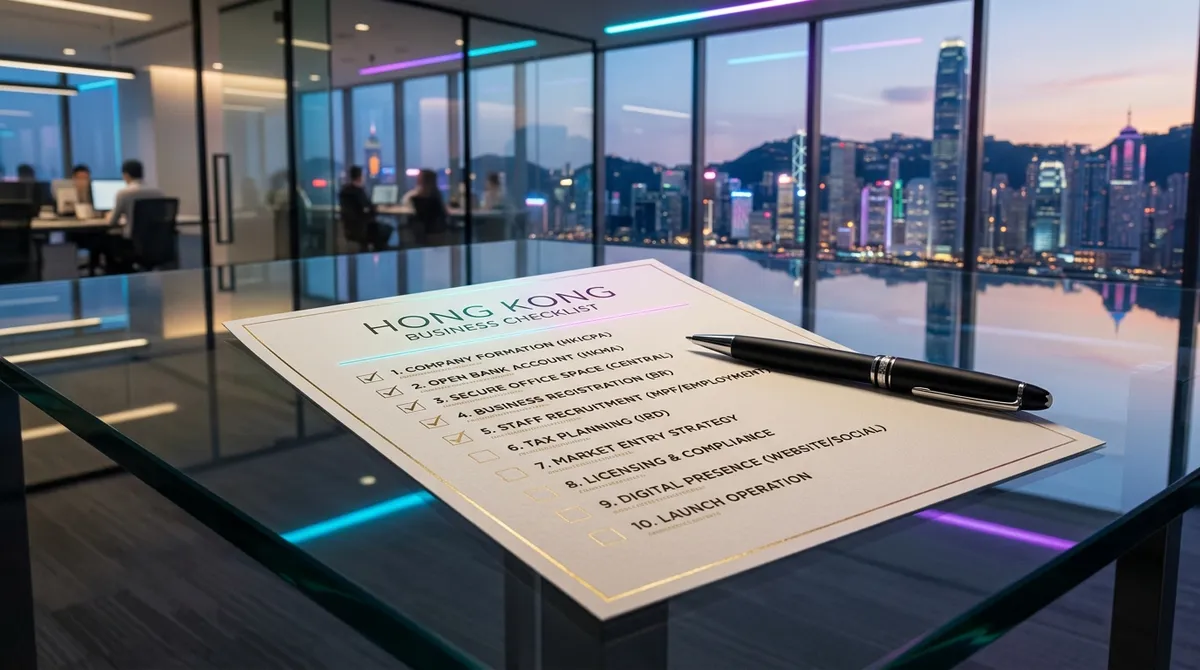
What to Do in the First 30 Days After Getting Your Hong Kong Company Registration Certificate? An Overlooked Operational Checklist
Many mainland traders breathe a sigh of relief the moment they receive their Hong Kong Company Certificate of Incorporation (CI) and Business Registration Certificate (BR), thinking "the company is finally registered, and we can start our grand plans." However, in reality, getting the registration certificate is just the starting line, and most fatal compliance risks do not occur during the registration process, but lurk within the 90 days after registration.
Many people do not know that Hong Kong companies are subject to "lenient entry, strict supervision". Registration is easy, but if subsequent maintenance is not carried out according to the statutory clock, you may face huge fines, compulsory deregistration of the company, and even personal criminal liability at any time. Especially after 2023, the Hong Kong Companies Registry and the Inland Revenue Department have unprecedentedly cracked down on non-compliant operations.
This article is a "30-day post-registration operational schedule" tailored for you. We will break down complex legal provisions into specific action steps to tell you exactly what you should do and what you should prevent during these crucial 30 days.
Chapter 1: The Statutory Clock — Deadlines You Cannot Miss
When operating a company in Hong Kong, the most important thing is "punctuality". The Hong Kong government has strict deadline requirements for various declarations, and missing even one day may result in fines. As a company director, you must have a "statutory clock" in your mind.
Here are a few key deadlines you must know by heart:
Within 1 month after registration: Obtain the Business Registration Certificate (BR) Although agents often apply for the Business Registration Certificate when registering a company nowadays, if your company was established through certain specific channels or has not yet obtained a BR, you must apply for business registration with the Business Registration Office under the Inland Revenue Department within 1 month after the company's incorporation. Failure to do so may result in fines and possible prosecution.
Within 15 days after registration: Establish the SCR (Significant Controllers Register) This is the most easily overlooked compliance item in the past few years, but the one with the strictest enforcement. The Hong Kong "Companies Ordinance" stipulates that all companies incorporated in Hong Kong must keep a Significant Controllers Register (SCR) at their registered office. This work must be completed within 15 days after the company's incorporation, even if your company only has you as the sole shareholder and director. The consequences of non-compliance are very serious and constitute a criminal offense. The company concerned and every responsible person may be subject to fines and even imprisonment.
Anniversary of company incorporation: Annual Return filing Hong Kong companies are required to conduct an "Annual Return" every year. The annual return includes submitting an Annual Return (AR) to the Companies Registry and renewing the Business Registration Certificate (BR) with the Inland Revenue Department. This work must be completed within 42 days after each anniversary of the company's incorporation. Please prepare one month in advance and never wait for the agent to urge you, because the fines for late submission increase exponentially (up to a maximum fine of HK$50,000 and a daily fine of HK$1,000).
Around 18 months after registration: First audit and tax return The first Profits Tax Return for a Hong Kong company is usually issued in the 18th month after the company's incorporation. You need to complete the first-year financial statement audit before this point. Please remember an iron rule: As long as your bank account has transaction flows, even if it's just one transaction, you absolutely cannot file a "zero return". The audit report must be issued by a practicing Certified Public Accountant in Hong Kong. Filing a false zero return constitutes tax evasion, and the consequences are extremely serious.
Summary of Key Compliance Deadlines
| Item | Deadline Requirement | Consequences of Non-compliance |
|---|---|---|
| Significant Controllers Register (SCR) | Establish within 15 days after registration | Criminal liability, facing a maximum fine of HK$25,000, plus a daily fine of HK$700 |
| Business Registration Certificate (BR) Collection | Within 1 month after registration | Fines and possible prosecution |
| Annual Return (AR) | Within 42 days after the anniversary date | Exponential fines, up to HK$50,000 and daily fines, company may be struck off |
| First Profits Tax Return | Tax return usually issued within 18 months of incorporation | Fines, estimated tax assessment; serious cases face criminal prosecution for tax evasion |
Chapter 2: Days 1-7, Three Essential Things to Do
The first seven days after getting the certificate is the best time to check for "hidden pitfalls" from your agency. Many people find non-compliant low-cost agents for the sake of cheapness, not knowing that this is equivalent to planting a time bomb in their own company. During these seven days, you need to personally verify the following three things.
1. Confirm whether the secretary company holds a TCSP license
Hong Kong law stipulates that any individual or institution providing company secretarial services in Hong Kong must hold a "Trust or Company Service Provider" (TCSP) license. A large number of low-cost agents actually do not have a license and are "black households" or attached to other licenses. If your statutory secretary does not have a TCSP license, the Hong Kong Companies Registry may take enforcement action against them at any time, which will directly lead to the risk of your company being struck off due to the lack of a legal statutory secretary. Action Guide: Ask your agency to provide its TCSP license number, then log in to the official website of the "Register of Trust or Company Service Provider Licensees" of the Hong Kong Companies Registry, input the number or name for verification, and ensure the license is in a valid status.
2. Confirm the compliance of the registered address
Your Hong Kong company must have a real Hong Kong address as its registered office address. Many low-cost agents will rent the same address to thousands of companies, and do not provide letter collection services at all, or the address has been blacklisted by the government due to non-compliance. If government letters (such as tax forms, court summons) sent to this address are returned, your company may be compulsorily deregistered. Action Guide: Search for your registered address on Google Maps to see if it is a real commercial building. Confirm whether your secretarial service agreement explicitly includes service terms for receiving and timely forwarding government and bank letters.
3. Familiarize yourself with and memorize your unique business identifier: BRN
This is an extremely important change that took effect at the end of 2023. Since December 27, 2023, the Business Registration Number (BRN) has officially replaced the Company Registration Number (CR No.) to become the unique business identifier for Hong Kong companies. In the past, companies needed to provide different numbers when dealing with different government departments, which caused great confusion. Now, whether submitting returns to the Companies Registry or filing taxes with the Inland Revenue Department, the Business Registration Number (BRN) must and can only be used. Action Guide: Take out your Business Registration Certificate and find the string of 8-digit numbers right in the middle of the certificate; this is your BRN (e.g., 12345678). From now on, please use this BRN in any official forms, bank documents, and business contracts. The CR No. is now history, so do not mix them up anymore.
Chapter 3: Days 8-14, Complete Preparation Before Bank Account Opening
After resolving the basic compliance, the core task of the second week is to prepare for bank account opening. Without a bank account, a Hong Kong company is just a shell and cannot carry out any substantive trade funds receipts and payments. But opening an account is precisely the biggest difficulty faced by mainland traders at present.
1. Understand the bottom line of the three types of banks and position yourself accurately
Do not blindly pursue traditional big banks; you should choose based on the actual business volume and background of your own company.
- Traditional Big Banks (e.g., HSBC, Standard Chartered, BOCHK): Suitable for traders with a certain scale, complete domestic company background, and abundant business proofs. Their rejection rate for "purely newly established mainland background enterprises with no domestic affiliated companies" is extremely high.
- Hong Kong Branches of Chinese Banks (e.g., CCB Asia, ICBC Asia): If your domestic company has good account flows in these banks, it will be relatively easier to open a Hong Kong account by utilizing internal linkage mechanisms.
- Virtual Banks (e.g., ZA Bank, Livi Bank, Airstar Bank): Fully online operations, fast account opening speed, very friendly to startups and asset-light traders. The disadvantage is that there is only online banking, no physical branches, and some banks may not support complex trade financing businesses such as letters of credit, but it is entirely sufficient to meet basic collection and payment needs.
2. Core Checklist for Account Opening Materials (General Version)
No matter which bank you choose, the following materials are essential "stepping stones." Please organize them completely within this week:
- Full Set of Company Documents: Certificate of Incorporation (CI), Business Registration Certificate (BR), Articles of Association (NNC1 and M&A/AA).
- Personal Identification: ID cards, passports/Hong Kong and Macau passes of all directors and shareholders holding more than 10% of shares, and personal address proofs for the past three months (such as utility bills, credit card statements).
- Business Proof (Core!): Business intention contracts (at least 2-3 procurement contracts and sales contracts), business plan (explaining the business model, main trading countries, expected turnover), domestic affiliated company's business license, and recent corporate bank statements (if any).
- Substantive Proof: Past bills of lading, customs declarations, VAT invoices, etc. (to prove you are doing real trade, not money laundering).
3. Three Questions You Must Prepare Answers For Before the Interview
The core purpose of the account opening interview (KYC due diligence) is to prevent money laundering. The bank manager will definitely ask you three core questions, and your answers must be logically rigorous and completely consistent with the materials submitted:
- "What is your source of funds?" (Many traders get stuck here. Never say "borrowed from a friend" or "not sure". You should clearly state that the startup capital comes from personal savings, shareholder injections, or profits from domestic affiliated companies, and be able to provide corresponding statement proofs.)
- "Where are your main trading countries and regions?" (Absolutely must not involve any countries under UN or US sanctions, such as Russia, Iran, North Korea, etc. State your mainstream markets truthfully.)
- "What are your expected annual transaction volume and account flows?" (Make a reasonable estimate based on the actual situation. Do not exaggerate the amount just to save face, otherwise the bank will ask you to provide stricter supporting documents, and it is also easy to cause the account to be reviewed later because the actual flow cannot be met.)
Chapter 4: Days 15-30, Implementation of Compliance Infrastructure
While submitting the account opening materials and waiting for review, you need to use the next two weeks to thoroughly consolidate the company's "compliance infrastructure".
1. Practical Operation of Establishing the Significant Controllers Register (SCR)
As mentioned earlier, the SCR must be established within 15 days. Specific Operations: First, you need to identify who the company's "significant controllers" are. Usually, those who directly or indirectly hold more than 25% of the company's shares, or possess more than 25% of the voting rights, or have the right to appoint or remove a majority of the board of directors, are significant controllers. Second, you must appoint a "Designated Representative". This representative must be a Hong Kong resident, a Hong Kong accountant, a Hong Kong lawyer, or a licensed TCSP institution. In most cases, your secretary company (if it is a licensed TCSP) will take on this role. Finally, ask your secretary company to issue a standard SCR form, fill in the detailed information of the significant controllers (name, address, ID number, date of becoming a controller, etc.), and keep it at the company's registered address (usually the secretary company's address) along with the designated representative's information, ready for inspection by Hong Kong law enforcement officers at any time. If you do not establish this register, you will face severe penalties if discovered.
2. Is a Company Chop (Seal) Really Necessary?
In Hong Kong's legal system, the "Companies Ordinance" does not strictly require a Hong Kong company to have or use a company seal (Common Seal or atomic chop). Many contracts are legally effective as long as a director signs them. However, in actual commercial operations, especially involving cross-border trade and banking businesses, we strongly recommend that you prepare a set of chops (usually containing a signature chop/strip chop, and a small round chop). The reason is simple: although not legally required, some banks still habitually require documents to be stamped with the company's authorized chop when signing account opening documents or handling counter businesses later; domestic partners also prefer to see contracts stamped with official seals to increase trust. Therefore, spending a little money to make a chop can save you a lot of unnecessary explanations and trouble.
3. Accounting and Bookkeeping: Starting from the First Transaction
A misconception of many bosses is: "Anyway, we don't have to file taxes until 18 months later, so we don't need to worry about the bills now." This is a huge mistake. When you need to do an audit 18 months later, if you do not have daily accounting vouchers, the accountant will ask you to reorganize every bank transaction, corresponding invoices, and contracts for the past year and a half. Not only is the workload huge, but it is also easy to miss things, causing the accounts to not balance, and you may even be issued an audit report with "qualified opinions" by the accountant, which will seriously affect your bank account security. Correct Practice: Starting from the opening of the account and the occurrence of the first income/expense, establish a complete archiving habit. Every bank transaction must correspond to a business contract, an invoice (Invoice), and corresponding logistics documents. Sort them monthly and hand them over to a professional accounting agency for processing.
4. Clarifying a Misconception: Hong Kong Does Not Require VAT/GST Registration
As a mainland trader, you may have heard of European VAT or Singapore GST, and wonder whether a Hong Kong company needs to register for them. Clear Answer: No. Hong Kong implements a very simple tax system with no Value Added Tax (VAT), Goods and Services Tax (GST), or Sales Tax. Hong Kong companies mainly involve only one tax type: Profits Tax (levied based on the pure profits generated by the company in Hong Kong). Therefore, you do not need to apply for any so-called VAT number from any department at this stage; just focus on business and the later Profits Tax audit.
Chapter 5: The 3 Most Commonly Overlooked Hidden Deadlines
In addition to the explicit statutory clock, there are three "hidden landmines" that are easily overlooked in the daily operation of Hong Kong companies.
1. Account Activity Maintenance (To Avoid Freezing)
If a bank account opened with great difficulty is not used for a long time, or only has incoming/outgoing funds, it can easily trigger the bank's anti-money laundering risk control model. Hidden Deadline: Generally, if an account has no transaction records for 3-6 consecutive months, the bank will downgrade the account's security rating, or even send letters requesting compliance reviews. If the review is not passed or replied to, the account will be frozen or compulsorily closed. Countermeasure: Maintain moderate activity in the account. Even in the business off-season, arrange some reasonable fund transfers (such as paying secretary fees, sporadic purchases, etc.), and ensure regular logins to online banking.
2. Notice Period for Changes in Statutory Secretary and Directors
If during operations you are dissatisfied with the existing agent and decide to change the statutory secretary, or if there are internal changes in directors and shareholders of the company, these cannot be completed just with an internal resolution. Hidden Deadline: Any changes regarding directors and company secretaries (including appointment, cessation of office, or changes in personal particulars) must be notified to the Companies Registry using specified forms within 15 days after the change occurs. Overdue notifications will also face fines.
3. Declaration Requirements for Change of Registered Address
Similarly, if you change your secretary company, the registered address will usually change accordingly. Hidden Deadline: Any change in the registered office address must be notified to the Companies Registry within 15 days after the change takes effect. If you miss important declarations (such as the issuance of tax returns) because you cannot receive government letters at the old address, the Inland Revenue Department will not listen to your explanations and will directly issue penalty notices or even estimated tax assessments.
Conclusion: Your Minimum Action Checklist
Having obtained the Hong Kong company registration certificate, you have taken the first step towards expanding global trade. Do not let compliance issues become a stumbling block to your business development. During these critical 30 days, you do not need to become an expert in Hong Kong company law, but you must complete this "Minimum Action Checklist":
- Verify the secretary's TCSP license and confirm the authenticity of the address.
- Urge the secretary company to establish the SCR register for you within 15 days.
- Familiarize yourself with your BRN number; this is your only passport from now on.
- Carefully prepare real business contracts and proofs of funds source to welcome the bank account opening interview.
- From the first day your bank account starts moving, archive the contracts, invoices, and transaction statements correspondingly.
By holding the bottom line of these 30 days, your Hong Kong company can truly become a solid battleship for you to brave the wind and waves.
Disclaimer: The content of this article is for information sharing and commercial popularization purposes only, and does not constitute any professional advice on legal, tax, or financial matters. Hong Kong's laws, regulations, and tax policies may be adjusted at any time, and the specific circumstances of each company also vary. Before making any commercial decisions or taking compliance actions, it is strongly recommended that you consult licensed Hong Kong practicing accountants, lawyers, or professional Trust or Company Service Providers (TCSPs) to obtain professional advice tailored to your case.